 埃森美語
埃森美語FCE 口說測驗
完整對話逐字稿
4 大題・14 分鐘(兩位考生一起)。全場 75 句,每一句英文下面都附中文。
FCE 口說 Part 2 要求的是「比較」兩張照片並推測原因,不是分別描述——這一個字的差別,是最多人丟分的地方。整場考試逐字寫在下面,每一句英文都附中文,Part 2 的一分鐘長回答完整保留,沒有切碎。
考試形式:one interlocutor (asks questions, manages timing) + one silent assessor。以下對話為埃森美語原創編寫的示範,用於熟悉流程與程度,非劍橋官方試題或官方錄音;兩位考生的表現設定為「這一級考得不錯」的水準,不是母語者。
Part 1:暖身,但已經在評分
2 分鐘考官問的都是很生活的問題——放學後做什麼、有什麼興趣——但從你開口的第一秒就已經在打分數了。這兩分鐘聽的是你能不能自然地回應,而不是背稿。台灣學生最常見的問題是答得太短:一句講完就停住,考官只好一直追問。合理的長度大概兩到三句,補一個理由或一個例子就夠了。
Good morning. Can I have your mark sheets, please? Thank you. I'm Helen Marsh, and this is my colleague David Chen. He's just going to listen to us. And your names are?
早安。可以把你們的成績單給我嗎?謝謝。我是 Helen Marsh,這位是我的同事 David Chen,他等一下只會在旁邊聽。請問你們的名字是?
I'm Yi-Chun.
我是 Yi-Chun。
And I'm Cheng-Hao.
我是 Cheng-Hao。
Thank you. Yi-Chun, where do you live?
謝謝。Yi-Chun,你住在哪裡?
I live in Banqiao, in New Taipei. I've lived there my whole life, actually — my school is about ten minutes away by bike.
我住板橋,在新北。其實我從小到大都住那裡——學校騎腳踏車大概十分鐘。
And you, Cheng-Hao?
那你呢,Cheng-Hao?
Banqiao as well, but we only moved there three years ago. Before that we were in Taichung.
我也住板橋,不過我們三年前才搬過去。在那之前是住台中。
Thank you. Now, let's talk about your free time. Yi-Chun, what do you usually do after school?
謝謝。那我們來聊聊你們的空閒時間。Yi-Chun,你放學後通常都做什麼?
It depends on the day. Most days I go straight to cram school until nine, so there isn't much free time, to be honest. But on Wednesday we finish early, and I usually play badminton with my cousin at the sports centre near my house.
看是哪一天。大部分日子我放學就直接去補習班,補到九點,老實說沒什麼自己的時間。不過禮拜三比較早下課,我通常會跟我表姊去我家附近的運動中心打羽球。
And you, Cheng-Hao? What do you usually do after school?
那你呢,Cheng-Hao?你放學後通常做什麼?
Erm, nothing very exciting. I go home, eat something, and then I'm on my computer for a couple of hours. I know I should do my homework first, but... it never really happens that way.
呃,沒什麼特別的。我回家、吃點東西,然後就坐在電腦前面兩個小時左右。我知道應該先寫功課,可是……從來都不是這樣。
Yi-Chun, tell us about a hobby you have had for a long time.
Yi-Chun,跟我們說說一個你維持很久的興趣。
I've been playing the piano since I was six, so that's about ten years now. I nearly gave it up in junior high because of exams, but my teacher let me choose my own pieces instead of the exam ones, and after that I enjoyed it again.
我從六歲開始學鋼琴,到現在大概十年了。國中的時候因為考試差點放棄,後來老師讓我自己挑要彈的曲子,不用彈檢定的曲目,之後我就又喜歡上了。
Thank you. Cheng-Hao, how much time do you usually spend on your phone each day?
謝謝。Cheng-Hao,你每天大概花多少時間在手機上?
Honestly? Too much. The screen time thing says about five hours, but some of that is music while I'm doing other stuff, so maybe it's not as bad as it looks. Or maybe I'm just making excuses.
老實說喔?太多了。螢幕使用時間顯示大概五個小時,不過有一部分是我在做別的事情的時候放音樂,所以可能沒有看起來那麼糟。也可能只是我在幫自己找藉口。
Part 2:一個人講一分鐘,重點是「比較」不是「描述」
4 分鐘(每人 1 分鐘長講,加上同伴約 30 秒的回答)每位考生拿到兩張照片和一個印在上面的問題,要自己講滿一分鐘。指令寫的是 compare,不是 describe——把兩張照片分開各描述一遍,是這個部分最常見的失分方式。講完之後,考官會問另一位考生一個約 30 秒的相關問題,接著兩人交換,第二位考生拿到的是另外兩張照片。
Thank you. Now, in this part of the test I'm going to give each of you two photographs. I'd like you to talk about your photographs on your own for about a minute, and also to answer a question about your partner's photographs. Yi-Chun, it's your turn first. Here are your photographs. They show teenagers spending their free time in different ways. I'd like you to compare the photographs, and say why the teenagers might have chosen to spend their free time in these ways. All right? Cheng-Hao, you just listen — I'll give you your photographs in a moment.
謝謝。接下來這個部分,我會各給你們兩張照片。請你自己針對照片講大約一分鐘,另外也要回答一個關於同伴照片的問題。Yi-Chun,先從你開始。這是你的照片,照片裡是青少年用不同的方式度過空閒時間。請你比較這兩張照片,並說說看這些青少年為什麼可能會選擇這樣運用空閒時間。可以嗎?Cheng-Hao,你先聽就好——我等一下會給你你的照片。
Okay, so — both photos show teenagers in their free time, but the atmosphere is completely different. In the first one, there are three friends sitting on a hill, laughing, and there's a map and a backpack next to them, so they've probably been hiking all afternoon. Whereas in the second one, there's just one boy on his own in his bedroom, and the curtains are closed, so it must be evening — the only light is coming from the screen. I think the group outside might have chosen that because they wanted to actually see each other, not just chat online, and maybe they'd been stuck indoors studying all week. The boy... it's harder to say. He might have wanted some quiet time after a long day, or, I mean, maybe his friends were busy, so gaming was just the easiest option. To be honest, the first group look happier in that moment, although you can't really tell from one photo — he could be enjoying himself just as much.
好,嗯——兩張照片都是青少年在過空閒時間,可是氣氛完全不一樣。第一張裡面有三個朋友坐在山坡上笑,旁邊放著地圖跟後背包,所以他們應該是走了一下午的步道。第二張就只有一個男生,一個人在自己房間,窗簾是拉上的,所以應該是晚上了——唯一的光是從螢幕來的。我覺得外面那一群人會選這樣過,可能是因為他們想真的見到面,不是只在網路上聊天,也可能是他們整個禮拜都被關在室內念書。那個男生……就比較難說。他可能是忙了一整天想安靜一下,或者,我是說,也可能他朋友剛好都有事,打電動就是最方便的選擇。老實說,那一刻第一組看起來是比較開心,不過從一張照片其實也看不出來——他說不定玩得一樣開心。
Thank you. Cheng-Hao, do you prefer to relax alone or with other people?
謝謝。Cheng-Hao,你比較喜歡自己一個人放鬆,還是跟別人一起?
Alone, definitely — well, most of the time. After a full day at school I just want to be in my room with the door shut for an hour. But the weekend is different; if I stay in for two days I start feeling a bit weird, so then I'll message someone. So I suppose I need both, just not on the same day.
自己一個人,絕對是——嗯,大部分時候啦。上了一整天課回家,我就只想關在房間裡一個小時。不過週末就不一樣,如果我兩天都待在家,會開始覺得怪怪的,那時候我就會傳訊息找人。所以我大概兩種都需要,只是不會在同一天。
Thank you. Now, Cheng-Hao, here are your photographs. They show teenagers spending time together in different places. I'd like you to compare the photographs, and say how the teenagers might be feeling in each situation.
謝謝。那麼 Cheng-Hao,這是你的照片,照片裡是青少年在不同的場合相處。請你比較這兩張照片,並說說看這些青少年在各自的情境裡可能有什麼感受。
Sorry, could you say the second part again?
不好意思,後面那一句可以再說一次嗎?
Of course. Compare the photographs, and say how the teenagers might be feeling in each situation.
當然可以。請比較這兩張照片,並說說看這些青少年在各自的情境裡可能有什麼感受。
Right, so in both pictures the teenagers are technically together, but I don't think they're feeling the same thing at all. In the first photo, two girls are sitting on the same bench with their bags between them, but each of them is looking at her own phone and neither of them is talking. They might be completely comfortable — sometimes you don't need to talk with a close friend — but they could also be a bit bored, or, I don't know, avoiding a conversation. Whereas in the second photo, a group are playing basketball, which they've obviously organised themselves because there's no coach or anything, and their bags and phones are all thrown in a pile at the side of the court. You can tell from their faces that they're really into it, so they're probably feeling more energetic, and more like part of something. If I had to guess, the basketball group will remember that evening, and the two girls on the bench won't remember it at all.
好,兩張照片裡的青少年嚴格說起來都是「在一起」,可是我覺得他們的感受完全不一樣。第一張是兩個女生坐在同一張長椅上,書包放在中間,可是兩個人各自看著自己的手機,誰都沒有在講話。她們可能覺得很自在——跟很熟的朋友本來就不一定要一直講話——但也可能是有點無聊,或者,我不知道,是在避開某個話題。第二張照片就是一群人在打籃球,看起來是他們自己揪的,因為旁邊沒有教練之類的,書包跟手機全都堆在場邊。從表情就看得出來他們很投入,所以應該是比較有活力,也比較有「我是其中一份子」的感覺。如果要我猜,籃球那群人會記得那個傍晚,長椅上那兩個女生大概完全不會記得。
Thank you. Yi-Chun, which of these two ways of spending time with friends would you prefer?
謝謝。Yi-Chun,這兩種跟朋友相處的方式,你比較喜歡哪一種?
The basketball one, easily. I'm not very good at it, but I don't mind — for me it's more about being outside with people. Sitting next to someone while we're both on our phones feels a bit pointless. Although, to be fair, my friends and I do exactly that in the queue at the drinks shop, so I can't really judge them.
籃球那一張,毫無疑問。我打得不太好,不過沒關係——對我來說重點是跟人一起在外面。跟朋友坐在一起、兩個人各自滑手機,我覺得有點沒意義。不過說句公道話,我跟我朋友在飲料店排隊的時候就是這樣,所以我也沒資格說她們。
Thank you.
謝謝。
Part 3:兩個人一起討論,最後必須做出決定
4 分鐘(約 15 秒讀題 + 2 分鐘討論 + 1 分鐘決定)桌上有一個中心問題和五個選項,兩人先看大約 15 秒,再一起討論兩分鐘,最後考官會請他們選出兩個。這裡評的不是英文有多漂亮,而是兩個人能不能真的互動——會不會接對方的話、會不會有禮貌地反對、會不會在時間內把話收尾。五個選項都要碰到,不能一開始就跳到答案。
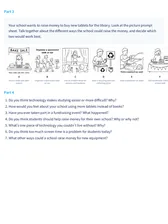
Now, I'd like you to talk about something together for about two minutes. Here are some ideas for how a school could help students spend less time on their phones. First you have some time to look at the task.
接下來請你們一起討論大約兩分鐘。這裡有幾個做法,是學校可以用來幫助學生減少使用手機時間的。先給你們一點時間看題目。
Now, talk together about how helpful each idea would be.
現在請你們一起討論,這幾個做法分別會有多大的幫助。
Okay, shall we start with the phone-free zones? I think that one's quite practical — you don't ban phones everywhere, you just make the library and the canteen phone-free.
好,我們要不要先從手機禁區開始?我覺得那個滿實際的——不是全部地方都禁用,只是把圖書館跟學生餐廳設成不能用手機。
Mm, maybe, but who's actually going to check? We already have a rule like that and nobody follows it, because no teacher wants to argue with thirty people at lunchtime.
嗯,也許吧,可是誰會真的去查?我們學校已經有類似的規定了,但根本沒人遵守,因為沒有老師想在午休時間跟三十個人吵架。
That's fair. Although if it's only two rooms, it's much easier to control than a whole-school ban, isn't it? One teacher can watch one room.
這樣說也對。不過如果只有兩個地方,那就比全校禁用好管很多,對吧?一個老師顧一間就好。
Yeah, okay, that's true. What about more after-school clubs? For me that's the strongest one, because it deals with the reason. Most of us aren't addicted, we're just bored.
嗯,好吧,這倒是真的。那課後社團多開一點呢?對我來說那個最強,因為它處理的是原因。我們大部分人不是上癮,只是無聊。
Hmm, I don't really agree. Clubs only attract students who already have something they like doing. The people on their phones four hours a day are not going to sign up for chess club.
嗯……我不太同意。社團只會吸引到本來就有喜歡的事情的人。一天滑四個小時手機的那些人,是不會去報名西洋棋社的。
I see what you mean, but — okay, honestly, if my school hadn't started a basketball club last year, I'd still be gaming every single night. It changed my whole routine.
我懂你的意思,不過——好啦,老實說,如果我們學校去年沒有開籃球社,我到現在應該還是每天晚上都在打電動。那真的改變了我整個作息。
Okay, that's a good point. I hadn't thought about it like that. Maybe it works if the clubs are things people actually want, not just whatever the teachers can supervise.
好,這點說得有道理,我沒有從這個角度想過。也許前提是社團要開大家真的想參加的,而不是只開老師顧得來的那幾種。
Exactly. Shall we move on? One phone-free day a month — I'm not sure about that one.
對,就是這樣。我們往下一個?每個月一天無手機日——那個我就不太確定了。
Me neither, to be honest. One day a month is more like a — an event? A symbol. You survive it and then Tuesday is normal again.
老實說我也是。一個月一天比較像是一個——活動?一個象徵。撐過那一天,禮拜二就又恢復原狀了。
Yeah. Although it might make people notice the habit, which is sort of the point. But no, long term it wouldn't change much.
對。不過它可能會讓人意識到自己的習慣,某種程度上這也是目的之一。但是不行,長期來看還是不會改變什麼。
What about rewards for classes that use phones less? I quite like competition, personally.
那給少用手機的班級獎勵呢?我個人還滿喜歡比賽的。
I don't. It would turn into everyone watching each other and reporting people, and then the whole class blames one student. Whoever thought of that must have forgotten what a class of thirty teenagers is like.
我不喜歡。那會變成大家互相盯著、互相告狀,最後全班怪一個人。想出這個辦法的人,一定是忘記三十個高中生的班級長什麼樣子了。
Ha, okay, I can see that going wrong. And how would they even measure it? You'd need the — sorry, I've forgotten the word — the box thing you put all the phones in at the start of the lesson.
哈,好啦,我可以想像那會出事。而且他們要怎麼算?你會需要那個——不好意思,我忘記怎麼講——上課前把手機通通放進去的那個箱子。
A phone locker, or a pouch, something like that. Which costs money, so a lot of schools wouldn't bother.
手機保管箱,或是手機袋,之類的。那要花錢,所以很多學校根本懶得弄。
Right. And the last one — less homework that needs a phone or a computer.
對。那最後一個——減少需要用手機或電腦的作業。
That one's interesting, because the school tells us to get off our phones and then sends three assignments on an app. It's a bit contradictory.
那個滿有意思的,因為學校一邊叫我們不要用手機,一邊又用 app 派三份作業下來。有點自相矛盾。
True, but that would have to be agreed by the whole school, not by one teacher, and some subjects genuinely need a computer. It can't be removed completely.
沒錯,可是那要全校一起決定,不是一個老師說了算,而且有些科目真的需要用到電腦。不可能完全拿掉。
No. Just less.
對,不可能。只是少一點。
Thank you. Now you have about a minute to decide which two ideas would work best. Remember, you don't have to agree.
謝謝。現在請你們用大約一分鐘決定,哪兩個做法效果會最好。記得,你們最後不一定要達成共識。
Okay, so — the phone-free zones for me, definitely. Which one would you pick?
好,那——我這邊一定是手機禁區。你會選哪一個?
Clubs. Easily clubs.
社團。絕對是社團。
Right, one each. I'm still not convinced clubs reach the people who need it most, but it clearly worked for you, so — fine, I can accept clubs as the second one.
好,那一人一個。我還是不覺得社團接得到最需要的那群人,但它對你確實有用,所以——好,第二個我可以接受社團。
And I'll take the zones, as long as it's only the library and the canteen. If they made the whole school phone-free, people would just hide in the toilets.
那我就接受禁區,前提是只有圖書館跟學生餐廳。如果整間學校都禁,大家只會躲到廁所裡用。
Agreed. So we're dropping the rewards and the phone-free day — they're both one-off things. They don't change the daily routine.
同意。所以我們把獎勵跟無手機日刪掉——那兩個都是一次性的,不會改變每天的作息。
And the homework one is good, but it's not really something a school can promise, is it?
作業那個雖然不錯,但那也不是學校真的能保證做到的,對吧?
No. So, shall we say phone-free zones and more after-school clubs?
對,不是。那我們就決定手機禁區跟多開課後社團,好嗎?
Yeah, let's go with those.
好,就這兩個。
Thank you.
謝謝。
Part 4:從「我的生活」升級到「我怎麼看這件事」
4 分鐘考官會問比較大的問題,例如學校該不該管手機、未來的學習會怎麼變。這裡要的是評價和判斷,不是資訊——把知道的事情列出來不會加分,講出立場和理由才會。另外,考官期待兩位考生互相回應,而不是各自輪流對考官報告。
Now, in this last part of the test we're going to talk about phones and free time more generally. Cheng-Hao, do you think schools are right to have rules about phone use?
接下來最後這個部分,我們來談談手機和空閒時間比較大範圍的問題。Cheng-Hao,你覺得學校訂手機使用規定是對的嗎?
Yes, I do, but only if the rule makes sense. The problem is when a rule exists just so the school can say it has one. If they explained the reason, most students would accept it — rules with no explanation just make people want to break them.
我覺得是對的,但前提是那個規定要說得通。問題出在有些規定的存在,只是為了讓學校可以說「我們有規定」。如果他們願意解釋理由,大部分學生其實會接受——沒有解釋的規定只會讓人想違反。
Yi-Chun, do you agree?
Yi-Chun,你同意嗎?
Mostly, although I'd go further than Cheng-Hao. I think a lot of students secretly want someone else to make the decision. If my phone is in my bag because of a rule, I don't have to pretend I have the self-control to leave it there myself. It's actually a kind of relief.
大致同意,不過我會比 Cheng-Hao 講得更極端一點。我覺得很多學生其實私底下希望有人幫他們做決定。如果我的手機是因為規定才放在書包裡,我就不用假裝自己有那個自制力。那其實是一種解脫。
That's... yeah, I hadn't thought of it that way. I still think it should be our own choice, but I do get what you mean about the relief part.
這……嗯,我沒有從這個角度想過。我還是覺得應該讓我們自己決定,不過你說的那種解脫感我懂。
Some people say teenagers are addicted to their phones. Do you agree? Yi-Chun?
有人說青少年對手機上癮。你們同意嗎?Yi-Chun?
I think 'addicted' is too strong a word. It's a habit, and habits are hard to break, but that's not the same thing. If you took my phone away for a day I'd be fine — annoyed, but fine.
我覺得「上癮」這個字太重了。那是一種習慣,而習慣本來就很難改,但那跟上癮不是同一回事。如果你把我的手機收走一天,我沒問題的——會不爽,但沒問題。
Yeah, but — sorry — for some people I'd say it is closer to an addiction. I used to check my phone before I was even properly awake, and that's not a normal habit. What annoys me is that adults call it a teenage problem, when it isn't only ours.
對,可是——不好意思——我覺得對某些人來說,那確實比較接近上癮。我以前是還沒完全醒來就先看手機,那不算正常的習慣。讓我不太舒服的是,大人都把它講成青少年的問題,可是這不是只有我們才有。
That's interesting. Do you think adults use their phones too much as well?
這點很有意思。你們覺得大人是不是也用太多手機?
Definitely. My dad watches short videos all the way through dinner and then tells me to put my phone away.
絕對是。我爸整頓晚餐都在看短影片,然後叫我把手機收起來。
Same in my house. Although in fairness, adults use them for work as well, so it's harder to judge from the outside. But yes — the rule should be the same for everyone in the house, not just for the kids.
我家也一樣。不過說句公道話,大人也會用手機工作,所以從外面看不太準。但沒錯——家裡的規定應該對每個人都一樣,不能只管小孩。
How do you think phones will change learning in the future? Cheng-Hao?
你們覺得手機未來會怎麼改變學習?Cheng-Hao?
I think the phone will basically become the textbook. We already use apps for vocabulary and everything gets scanned and uploaded. The risk is that if you can look anything up in two seconds, you stop remembering things.
我覺得手機基本上會變成課本。我們現在背單字就已經在用 app 了,什麼東西都掃描上傳。風險是,如果什麼都能兩秒查到,你就不會再去記東西了。
I'm not sure I agree with that last part. People said exactly the same about calculators, and we still learn maths — we just learn different parts of it. What worries me more is that not every family can afford a good phone, so the gap between students could get wider.
最後那一點我不太同意。以前大家講計算機的時候講的一模一樣,可是我們還是有在學數學——只是學的部分不一樣了。我比較擔心的是,不是每個家庭都買得起好手機,學生之間的差距可能因此拉得更大。
Okay, that's a much better argument than mine, honestly. I hadn't thought about the cost at all.
好吧,老實說那個論點比我的好太多了。我完全沒想到費用的問題。
And what could parents do at home to help with this problem?
那家長在家裡可以做些什麼來幫忙處理這個問題?
Set a time, not a number of hours. Something like: no phones after ten, for everybody. That's much easier to follow than two hours a day, because nobody actually counts.
訂一個時間點,不要訂時數。像是:十點以後全家都不用手機。那比「一天兩小時」好遵守多了,因為根本沒有人在算。
And do it themselves. If my parents put their phones in the kitchen at ten as well, I'd have nothing to argue about. It's the double standard that makes people resist, more than the rule itself.
而且自己也要做到。如果我爸媽十點也把手機放在廚房,我就沒什麼好吵的了。讓人想抗拒的是那個雙重標準,而不是規定本身。
Thank you. That is the end of the test.
謝謝。測驗到此結束。
想整份計時做完嗎?
這一頁的線上練習永遠免費。想整份計時做完,我們自己出了完整模擬試卷——題目卷、中文逐題解析、聽力音檔。線上刷卡不用離開這一頁,付款後檔案立刻寄到信箱。

這些句子,背起來就能用
口說不是背整段稿子——考官聽得出來。真正有用的是這些「隨時可以接上去」的短句:給理由、表達保留、問對方意見。
推測
- I might try... at some point.我之後可能會想試試看…
- I'm not sure, but I think...我不太確定,不過我覺得…
讓步
- I used to think that, but actually...我以前是這樣想,但其實…
- That's fair, although in my case...這樣說也對,不過我自己的情況是…
給理由
- I really enjoy it because...我很喜歡,因為…
- That matters to me since...這對我來說很重要,因為…
保留語氣
- I'd say most days...大概可以說大部分日子…
- It depends, but usually...看情況,不過通常…
比較
- whereas / while然而/而(用來對比兩件事)
- unlike the first photo...不像第一張照片…
推測
- It looks as if...看起來好像…
- They might be...他們可能是…
讓步
- I could be wrong, but...我可能猜錯,不過…
給理由
- probably because...可能是因為…
保留語氣
- If I had to guess...如果要我猜的話…
給理由
- That would work well because...這樣做應該會有效,因為…
讓步
- That's a good point, but I think...你說得有道理,不過我認為…
- I see what you mean, although...我懂你的意思,不過…
推測
- That might not work if...如果…的話,這可能行不通
保留語氣
- I'm not sure this is the best one, but...我不確定這是不是最好的選項,不過…
給理由
- I think that's fair because...我覺得這樣講合理,因為…
- The main reason is...主要原因是…
讓步
- I partly agree, but...我部分同意,不過…
- That's true to some extent, however...這在某種程度上是對的,不過…
推測
- I think in the future...我覺得未來…
- It's likely that...很有可能…
保留語氣
- I'm not completely sure, but my guess is...我不是很確定,不過我猜…
逐字稿看得懂,不等於開得了口
口說是唯一沒辦法自己在家對答案的一卷——要有人聽、有人接話、有人在你卡住的時候指出是哪個字沒出來。我們的課由美籍持證教師在全美語小班裡上,每一堂都在做這件事。文法沒站穩也會拖累口說,可以順便對照 FCE 文法範圍逐項教學。
LINE 預約免費口說程度評估