官方沒有清單 · 我們自己整理

FCE(B2 First)文法範圍
官方沒有清單,我們自己整理

作者:Christopher|埃森美語創辦人|美國密西根大學畢業、美國正式教師執照|最後更新

這一頁和它的兩個兄弟頁不一樣,要先講清楚差在哪裡。A2(KET)和 B1(PET)的文法範圍,劍橋在教師手冊裡都有一段名為「Language specifications」的官方附錄;到了 B2 First,這份附錄不存在——我們把 90 頁官方教師手冊逐字讀過、逐字搜過,「Appendix」出現零次。手冊自己也承認了這件事:在 Writing 的評分術語表裡,它寫著「在較低等級(如 A2 Key 與 B1 Preliminary)有提供 language specifications 的地方……」——換句話說,劍橋親口確認低階有、B2 沒有。

但「沒有官方清單」不等於「沒有範圍」。同一份術語表把「複雜文法形式」定義為:名詞子句、關係與副詞子句、從屬結構、被動、不定詞、動詞句型、情態形式與時態對比——這是官方文件裡最接近 B2 文法大綱的一段話。我們以它為起點,再把 Reading and Use of English 四大題的官方題型說明、以及兩份官方樣卷的每一題答案逐一比對,整理出 14 個 B2 真正會考、而 B1 不要求的文法項目。每一項下面都寫得出它是哪一份樣卷的哪一種題目在考。

再說一次,因為這很重要:這 14 項是埃森美語整理的,不是劍橋公告的。我們拿它當教學地圖用,不會把它包裝成官方大綱——市面上那些看起來很正式的「FCE 必背文法表」,也同樣不是官方文件。

目錄

14 個 B2 考點,點進去直接看

逐項拆解

一項一項,每一項都指得出哪一題在考

02

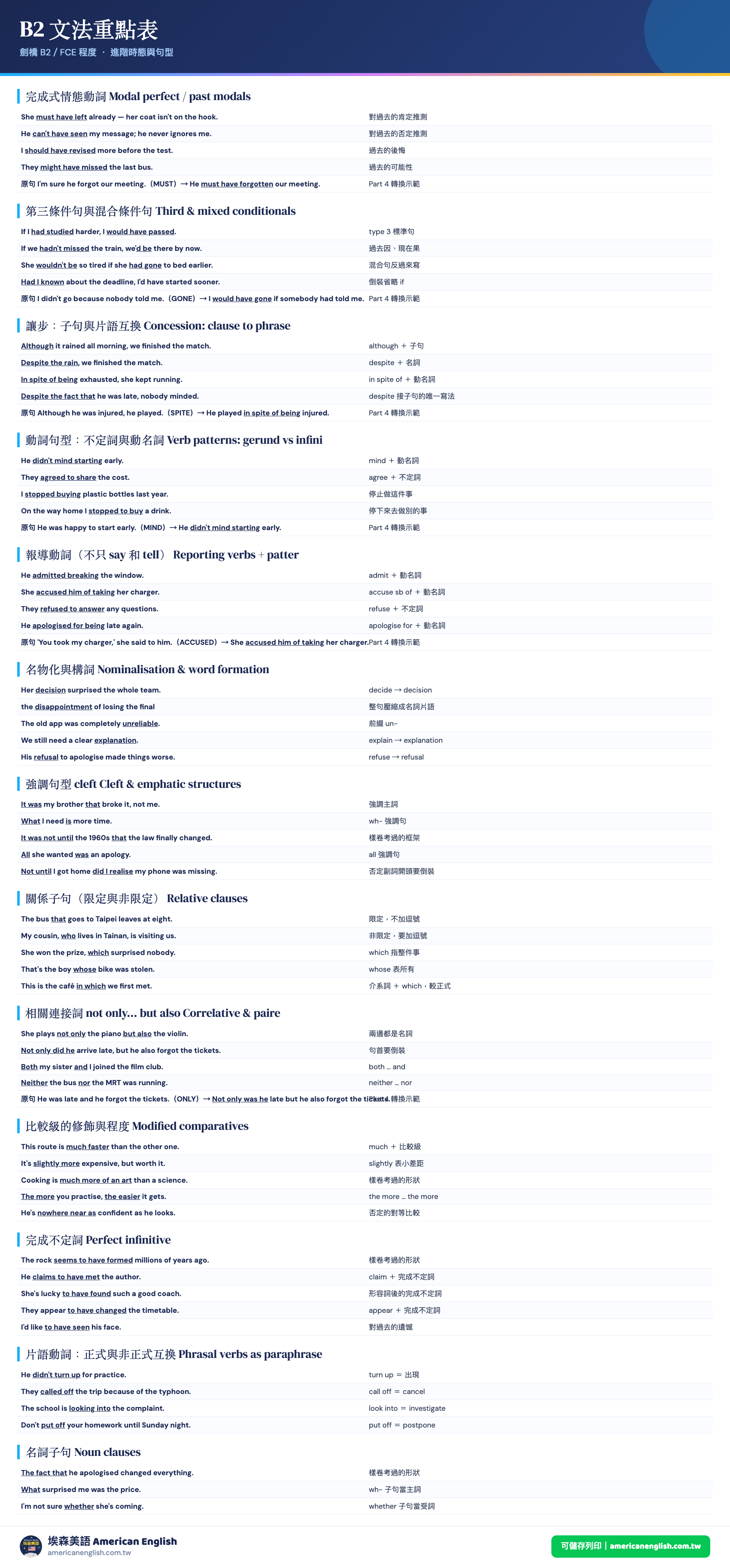
第三條件句與混合條件句Third & mixed conditionals

RUoE Part 4 關鍵字轉換

If + had + 過去分詞, would have + 過去分詞;以及兩個時間軸交錯的 mixed conditional

官方 B1 只到第二條件句,第三條件句要到 B2 才正式進場——與過去事實相反的假設,加上把過去的原因接到現在的結果的混合條件句。我們比對過的兩份官方樣卷,Part 4 都出現了這一類。難的不是文法規則,是中文兩邊都說「就會」,英文卻兩邊形狀完全不對稱。

If I had studied harder, I would have passed.type 3 標準句
If we hadn't missed the train, we'd be there by now.過去因、現在果
She wouldn't be so tired if she had gone to bed earlier.混合句反過來寫
Had I known about the deadline, I'd have started sooner.倒裝省略 if
原句 I didn't go because nobody told me.(GONE)→ I would have gone if somebody had told me.Part 4 轉換示範
台灣孩子最常錯的一題
✗If I would have known, I would have called.
✓If I had known, I would have called.

would 不能出現在 if 子句裡。記法很簡單:if 那半邊只放 had + 過去分詞,would 一律留給另外半邊。

再上一級再往上會加上 but for、if it hadn't been for 這類把整個條件壓縮成介系詞片語的寫法。
做 6 題練習,看看這一類站穩了沒

1.If I ______ harder, I would have passed the listening paper.

A:✗ 過去簡單式是第二條件句的形狀,和後半句的 would have passed 對不上。

B:✓ 與過去事實相反的第三條件句:if + had + 過去分詞,主要子句用 would have + 過去分詞。

C:✗ would 一律留給逗號後面那半句,不能出現在 if 子句。

D:✗ have studied 是現在完成式,不能用在與過去相反的假設。

2.If Mia ______ about the deadline, she would have handed the form in on time.

A:✗ if 子句裡不放 would,這是台灣考生最整齊的一個錯。

B:✓ if 那半邊只放 had + 過去分詞,would 全部留給另外半邊。

C:✗ knew 是第二條件句的形狀,講的是與現在相反,不是與過去相反。

D:✗ would know 同樣把 would 放進了 if 子句。

3.填入一個字:If we hadn't missed the last train, we ______ be in Taichung by now.

混合條件句:if 子句是過去(hadn't missed),結果卻落在現在(by now),所以後半句用 would + 原形動詞,不是 would have been。時間線索就是 by now。

4.She's exhausted today. If she ______ to bed earlier last night, she wouldn't be so tired now.

A:✗ 過去簡單式配不上 last night 這個與過去事實相反的假設。

B:✓ 混合條件句:原因在過去用 had gone,結果在現在用 wouldn't be,兩邊的時間軸本來就不一樣。

C:✗ would 不能出現在 if 子句。

D:✗ 現在完成式不能用在假設語氣裡,而且與 last night 衝突。

5.Ben didn't revise at all, so he failed the test.

HAD

Ben would have passed the test ______ .

原句兩件事都發生在過去而且都是事實,改寫成假設就要整組反過來:沒複習變成 had revised,沒通過變成 would have passed。關鍵字 HAD 已經告訴你 if 那半邊要用什麼形狀。

6.I missed the sign-up deadline last week, so I'm not in the team now.

WOULD

If I hadn't missed the deadline last week, I ______ the team now.

這是混合條件句:if 子句停在過去,主要子句卻落在 now,所以答案是 would be,不是 would have been。看到 now 就知道結果講的是現在。

↑ 回到目錄
03

讓步:子句與片語互換Concession: clause to phrase

RUoE Part 4 / Part 2

although/even though/though ↔ despite/in spite of/nevertheless

B1 已經會用 although,B2 要求的是同一個意思換一種結構寫出來——子句換成片語,片語換成子句。我們看過的兩份官方樣卷 Part 4 都考了這個轉換,關鍵字分別是 SPITE 和 even though。這也是台灣孩子錯得最整齊的一項,因為中文的「雖然……但是……」天生成對出現。

Although it rained all morning, we finished the match.although + 子句
Despite the rain, we finished the match.despite + 名詞
In spite of being exhausted, she kept running.in spite of + 動名詞
Despite the fact that he was late, nobody minded.despite 接子句的唯一寫法
原句 Although he was injured, he played.(SPITE)→ He played in spite of being injured.Part 4 轉換示範
台灣孩子最常錯的一題
✗Although it was expensive, but we bought it.
✓Although it was expensive, we bought it.

中文的「雖然」一定要配「但是」,英文只能留一個。看到 although、though、even though,後面那個 but 就該刪掉。

再上一級再往上會要求 while 與 whereas 用在對比而不是讓步,以及 albeit 這種正式書面語的分寸。
做 6 題練習,看看這一類站穩了沒

1.______ the heavy rain, the night market stayed open until midnight.

A:✗ although 後面要接完整子句,the heavy rain 只是名詞片語。

B:✓ despite 後面接名詞或動名詞,剛好配 the heavy rain。

C:✗ even though 同樣要接主詞加動詞的完整子句。

D:✗ however 是副詞,要放在句號或分號之後,不能直接帶出名詞片語。

2.______ she had trained for six months, she didn't finish the race.

A:✗ despite 接名詞或動名詞,接不了 she had trained 這個子句。

B:✗ in spite of 後面同樣只能接名詞或動名詞。

C:✓ 後面是完整子句,就要用 although、though 或 even though 這一組。

D:✗ 英文沒有 despite of 這個寫法,要嘛 despite,要嘛 in spite of。

3.填入一個字:In ______ of the traffic on the bridge, we got to the stadium before kick-off.

in spite of 是三個字一組的固定片語,中間那個 spite 不能換也不能省。它和 despite 意思一樣,差別只在 despite 沒有 of。

4.Despite ______ he was injured, he played the whole second half.

A:✗ despite 不能直接接子句,中間少了名詞。

B:✓ 要讓 despite 後面接子句,唯一的寫法是 despite the fact that,因為 the fact 是它需要的那個名詞。

C:✗ despite 後面不加 of,加 of 的是 in spite of。

D:✗ despite 和 although 是同一份工作做兩次,就像中文「雖然……但是……」成對出現,英文只能留一個。

5.Although she was very nervous, she gave a brilliant presentation.

SPITE

She gave a brilliant presentation ______ very nervous.

子句換片語的標準動作:主詞 she 消失,was 變成動名詞 being,因為 in spite of 是介系詞片語,後面只收名詞或 Ving。

6.Even though the weather was terrible, the concert went ahead.

DESPITE

The concert went ahead ______ weather.

這一題要把整個子句壓成名詞片語:the weather was terrible 裡的形容詞 terrible 搬到名詞前面,變成 the terrible weather。despite 後面不放 of,也不放主詞加動詞。

↑ 回到目錄
04

動詞句型:不定詞與動名詞Verb patterns: gerund vs infinitive

RUoE Part 4 / Part 1

verb + to V/verb + Ving/verb + 受詞 + to V;stop、remember、forget、try 的意義差別

這一項沒有規則可以推,只能一個動詞一個動詞記住後面接什麼。B2 的 Part 4 常常靠它決定答案要填幾個字,Part 1 也用它設四選一的陷阱。更麻煩的是 stop、remember、forget、try 這幾個字,接 to V 和接 Ving 意思完全不同——不是風格差異,是兩件事。

He didn't mind starting early.mind + 動名詞
They agreed to share the cost.agree + 不定詞
I stopped buying plastic bottles last year.停止做這件事
On the way home I stopped to buy a drink.停下來去做別的事
原句 He was happy to start early.(MIND)→ He didn't mind starting early.Part 4 轉換示範
台灣孩子最常錯的一題
✗I suggest to go earlier.
✓I suggest going earlier.

suggest、recommend、avoid、practise 一律接動名詞。中文「建議去」的「去」看起來就是原形動詞,所以 to go 特別順手,但英文不收。

再上一級再往上會加上 verb + 受詞 + Ving 與 verb + 受詞 + 過去分詞的差別,以及被動的不定詞 to be done。
做 6 題練習,看看這一類站穩了沒

1.In the end they all agreed ______ the cost of the taxi.

A:✗ agree 後面不接動名詞。

B:✓ agree 屬於接不定詞的那一組,寫成 agree to V。

C:✗ 情態動詞後面才直接接原形,一般動詞不行。

D:✗ to share 的 to 是不定詞記號,後面要接原形,不是 Ving。

2.Would you mind ______ the window? The whole room is freezing.

A:✗ mind 後面不接不定詞。

B:✗ 一般動詞後面不能直接接另一個原形動詞。

C:✓ mind 屬於接動名詞的那一組,Would you mind + Ving 是固定的客氣說法。

D:✗ 過去分詞在這裡會變成被動的意思,語意不通。

3.填入一個字,把 leave 改成正確的形式:I suggest ______ before the traffic gets bad.

suggest、recommend、avoid、practise 一律接動名詞。中文「建議走」的「走」看起來就是原形動詞,所以 to leave 特別順手,但英文不收這個形狀。

4.On the way home I stopped ______ a drink, then carried on walking.

A:✗ stop + Ving 是「不再做這件事」,意思會變成他從此不買飲料了,與 then carried on walking 對不上。

B:✓ stop + to V 是停下腳步去做另一件事,線索是後半句他又繼續走。

C:✗ stop 後面不能直接接原形動詞。

D:✗ for + Ving 用來說明用途,不用在這個句型。

5.She was quite happy to wait outside.

MIND

She ______ outside.

「不介意」等於「還算樂意」,所以肯定的 was happy 改寫後要變成否定的 didn't mind。改寫時形狀也跟著換:mind 後面接動名詞 waiting,不是 to wait。

6.I locked the back door, and I'm completely certain about it.

REMEMBER

I ______ the back door.

remember + Ving 是「記得做過」,remember + to V 是「記得要去做」。原句的動作已經完成,所以只能用 remember locking,寫成 remember to lock 就變成還沒鎖。

↑ 回到目錄
05

報導動詞(不只 say 和 tell)Reporting verbs + patterns

RUoE Part 4 關鍵字轉換

admit/deny/accuse sb of/apologise for/insist on/refuse to/warn sb not to

B1 的間接引述只要求 say、ask、tell 三個字。B2 要求你選出「說話的方式」——他是承認、否認、指控,還是拒絕——而且每一個動詞後面接的形狀都不一樣。官方樣卷的 Part 4 就考過 accuse sb of doing 這種介系詞加動名詞的組合,答對與否往往只差那個 of。

He admitted breaking the window.admit + 動名詞
She accused him of taking her charger.accuse sb of + 動名詞
They refused to answer any questions.refuse + 不定詞
He apologised for being late again.apologise for + 動名詞
原句 'You took my charger,' she said to him.(ACCUSED)→ She accused him of taking her charger.Part 4 轉換示範
台灣孩子最常錯的一題
✗He denied to break the window.
✓He denied breaking the window.

deny、admit 接動名詞,refuse、promise 才接不定詞。這些沒有邏輯可循,背的時候要把介系詞一起背進去,才不會臨場猜。

再上一級再往上會加上 insist that he be told 這種報導動詞後的假設語氣,以及更細的語氣強弱區分。
做 6 題練習,看看這一類站穩了沒

1.He finally admitted ______ the window during the lunch break.

A:✗ admit 後面不接不定詞。

B:✓ admit 和 deny 都接動名詞,寫成 admit + Ving。

C:✗ 一般動詞後面不能直接接原形動詞。

D:✗ 過去分詞在這裡會讀成被動,語意不通。

2.The club ______ to answer any questions about the cancelled trip.

A:✓ 空格後面是 to answer,只有 refuse 屬於接不定詞的那一組。

B:✗ deny 接動名詞,不接不定詞。

C:✗ admit 同樣接動名詞。

D:✗ apologise 後面要先加 for,再接動名詞。

3.填入一個字:She accused him ______ taking her charger without asking.

accuse 的完整形狀是 accuse sb of + 動名詞,那個 of 就是 Part 4 最常被挖掉的一格。背報導動詞時要把介系詞一起背進去,才不會臨場猜。

4.He ______ having anything to do with the missing money.

A:✓ 空格後面直接接動名詞 having,符合這個形狀的只有 deny,意思也對得上「否認做過」。

B:✗ refuse 接不定詞,而且意思是拒絕去做某事,不是否認。

C:✗ apologise 後面必須加 for 才能接動名詞。

D:✗ insist 後面必須加 on 才能接動名詞。

5."You copied my homework," Ryan said to Lily.

ACCUSED

Ryan ______ his homework.

直接引語改成報導動詞時,聽話的人要變成受詞:accuse + 人 + of + 動名詞。漏掉 of 或把 copying 寫成 to copy,這一格就整個不給分。

6."You really must let me pay for the tickets," said Hana.

INSISTED

Hana ______ for the tickets.

insist 的形狀是 insist on + 動名詞。這裡還要注意主詞換人:原句是 Hana 堅持要自己付,所以動名詞的動作者就是 Hana,不需要再寫出來。

↑ 回到目錄
06

名物化與構詞Nominalisation & word formation

RUoE Part 3 構詞 / Part 4

動詞與形容詞轉名詞(decide → decision、disappoint → disappointment)、前綴與後綴

Reading and Use of English 的 Part 3 整整一大題只考這件事:給你字根,要你變出句子需要的詞性。它同時也是 B2 寫作看起來成熟的關鍵——把「他很失望,因為輸了」寫成 the disappointment of losing,同樣的意思,句子的密度完全不同。這是少數練了就一定看得到分數的項目。

Her decision surprised the whole team.decide → decision
the disappointment of losing the final整句壓縮成名詞片語
The old app was completely unreliable.前綴 un-
We still need a clear explanation.explain → explanation
His refusal to apologise made things worse.refuse → refusal
台灣孩子最常錯的一題
✗The develop of the app took two years.
✓The development of the app took two years.

中文的「發展」當名詞和動詞是同一個詞,英文不是。看到 the 或所有格在前面,後面就必須是名詞形——這個檢查一秒就能做。

再上一級再往上會要求同一個字根的整組家族都用得準(economy/economic/economical/economically)。
做 6 題練習,看看這一類站穩了沒

1.Her ______ to change schools surprised the whole class.

A:✗ decide 是動詞原形,所有格 Her 後面放不了動詞。

B:✗ decided 是過去式或過去分詞,同樣不能接在所有格後面。

C:✓ 前面有所有格 Her,後面就必須是名詞形 decision,這個檢查一秒就能做。

D:✗ deciding 是動名詞,這個字的標準名詞形是 decision。

2.The teacher gave us a very clear ______ of the new marking system.

A:✓ 前面有冠詞 a 和形容詞 clear,這個位置只能放名詞。

B:✗ 動名詞前面不加冠詞,也不用形容詞修飾。

C:✗ explain 是動詞原形。

D:✗ explanatory 是形容詞,兩個形容詞疊在一起後面卻沒有名詞。

3.填入一個字,用 DISAPPOINT 造出正確的詞:You could see the ______ on their faces after the final whistle.

冠詞 the 後面要放名詞,動詞 disappoint 的名詞形是 disappointment。Part 3 就是整整一大題在做這件事:先看空格前後的位置決定詞性,再去變字尾。

4.The school's old booking app was completely ______ , so nobody used it.

A:✓ be 動詞加副詞 completely 之後要放形容詞,反義前綴是 un-。

B:✗ 副詞不能當 be 動詞的補語。

C:✗ 這個字的反義前綴是 un-,不是 dis-。

D:✗ 名詞形前面缺了冠詞,而且 completely 也修飾不了名詞。

5.He refused to apologise, and that made everything worse.

REFUSAL

His ______ made everything worse.

把一整個子句壓成名詞片語:動詞 refused 變成名詞 refusal,後面接的不定詞 to apologise 保持不變。這就是讓 B2 寫作看起來成熟的那一步。

6.Everyone could see that the team was disappointed about losing the final.

DISAPPOINTMENT

The team's ______ the final was obvious to everyone.

形容詞 disappointed 轉成名詞 disappointment 之後,後面那個介系詞要跟著調整,接 at 或 about + 動名詞。名詞化最常掉分的地方不是字尾,是後面的介系詞。

↑ 回到目錄
07

強調句型 cleftCleft & emphatic structures

RUoE Part 2 開放式克漏字

It was … that/What … is/All (that) … is/Not until … did

B2 開始要求把重點搬到句首的能力。這不是裝飾——官方樣卷的 Part 2 就有一整題在考你認不認得 It was not until … that 這個框架,而答案只是一個 it 或一個 that。認得框架的孩子秒填,不認得的會在那一格卡到最後。

It was my brother that broke it, not me.強調主詞
What I need is more time.wh- 強調句
It was not until the 1960s that the law finally changed.樣卷考過的框架
All she wanted was an apology.all 強調句
Not until I got home did I realise my phone was missing.否定副詞開頭要倒裝
台灣孩子最常錯的一題
✗It was in 2019 when we moved to Banqiao.
✓It was in 2019 that we moved to Banqiao.

強調句的第二格固定是 that,不管強調的是人、時間還是地點。中文「是在 2019 年的時候」讓 when 聽起來很順,但這個框架不收 when。

再上一級再往上會加上 The reason why … is that … 與被動的強調句,以及用強調句控制整段論述的節奏。
做 6 題練習,看看這一類站穩了沒

1.______ my little brother that broke the controller, not me.

A:✓ 強調句的框架是 It was … that,把重點搬到句首。

B:✗ There was 用來表示某處存在某物,帶不出這個框架。

C:✗ That was 後面接不了這個 that 子句。

D:✗ broke 是過去式,框架的 be 動詞要一起用過去式。

2.______ this team needs most is a decent goalkeeper.

A:✗ that 引導的子句本身要完整,但這裡的 needs 後面缺了受詞。

B:✓ wh- 強調句的框架是 What … is,what 同時當引導詞和子句裡的受詞。

C:✗ which 用在有先行詞的關係子句,這裡句首沒有先行詞。

D:✗ it 開頭的強調句要配 that,不能直接接 needs。

3.填入一個字:It was not until I got home ______ I realised my phone was missing.

It was not until … that 是一個完整的框架,第二格永遠是 that。認得框架就是一秒填完,不認得就會卡到最後一格。

4.Not until the second half ______ how strong the other team was.

A:✗ 否定副詞放句首時不能維持正常語序。

B:✓ Not until 開頭要像問句一樣倒裝:助動詞 did 提到主詞前面,動詞回到原形 realise。

C:✗ 語序不對,did 必須放在主詞 we 的前面。

D:✗ 倒裝對了,但 did 後面要接原形,不能再用過去式。

5.We first met in that café on Wenhua Road.

IT

______ that café on Wenhua Road that we first met.

強調地點時,介系詞要跟著被強調的部分一起搬到前面,所以是 It was in that café … that。第二格不管強調人、時間還是地點,都固定用 that,不能寫 where。

6.She only wanted an apology, nothing else.

ALL

______ an apology.

All (that) she wanted 這個主詞是一個名詞子句,整團算單數,所以後面的動詞用 was。原句的 only 改寫成 all 之後就不再出現,這是 Part 4 常見的等值互換。

↑ 回到目錄
08

關係子句(限定與非限定)Relative clauses

RUoE Part 2 開放式克漏字

who/which/that/whose/where;非限定要加逗號;介系詞 + which

B1 已經教過關係代名詞,B2 要求的是逗號有沒有的差別——有逗號是補充說明,拿掉句子還完整;沒有逗號是限定,拿掉就不知道在講誰。官方樣卷的 Part 2 直接考過一個非限定的 which。手冊自己在評分術語表裡列舉「複雜文法形式」時,也點名了關係子句。

The bus that goes to Taipei leaves at eight.限定,不加逗號
My cousin, who lives in Tainan, is visiting us.非限定,要加逗號
She won the prize, which surprised nobody.which 指整件事
That's the boy whose bike was stolen.whose 表所有
This is the café in which we first met.介系詞 + which,較正式
台灣孩子最常錯的一題
✗My cousin, that lives in Tainan, is visiting us.
✓My cousin, who lives in Tainan, is visiting us.

逗號後面不能用 that。非限定子句只能用 who、which、whose——這是改作文時一眼就看得到的一條線。

再上一級再往上會要求簡化關係子句(the boy standing there)與 of which 這類更緊縮的寫法。
做 6 題練習,看看這一類站穩了沒

1.The girl ______ won the speech contest is in my art class.

A:✗ which 指事物,先行詞 the girl 是人。

B:✓ 先行詞是人而且在子句裡當主詞,用 who,沒有逗號表示這是限定用法。

C:✗ whose 表所有,後面要接名詞。

D:✗ where 指地點,先行詞不是地方。

2.That's the boy ______ bike was stolen outside the library.

A:✗ who 當主詞,後面要接動詞,不能接名詞 bike。

B:✗ who's 是 who is 的縮寫,讀起來一樣但意思完全不同。

C:✓ 空格後面是名詞 bike,表示「那個男生的腳踏車」,所有格用 whose。

D:✗ which 指事物,而且不表示所有。

3.填入一個字:She won the science prize, ______ surprised absolutely nobody.

逗號後面指的是「她得獎」這整件事,只有 which 能代表一整個子句。這裡不能用 that(非限定子句不收 that),也不能用 what。

4.My cousin, ______ lives in Tainan, is coming to stay with us next week.

A:✗ 逗號後面不能用 that,這是改作文時一眼就看得到的一條線。

B:✓ 非限定子句只收 who、which、whose,先行詞是人就用 who。

C:✗ which 指事物,不指人。

D:✗ 兩個子句不能只靠逗號和代名詞連起來,需要關係代名詞。

5.That's the classroom. Our film club meets in it every Friday.

WHICH

That's the classroom ______ our film club meets every Friday.

把兩句併成一句時,代名詞 it 變成 which,原本的介系詞 in 提到 which 前面,寫成 in which,語域比較正式。口語會說 which our film club meets in,但關鍵字題要的是前置的那一種。

6.I sat next to a boy at the match. His father coaches our team.

WHOSE

I sat next to a boy ______ our team.

his 這個所有格代名詞併句之後就是 whose,而且 whose 後面直接接名詞,中間不加冠詞。動詞維持第三人稱單數的 coaches,因為主詞是 father。

↑ 回到目錄
09

相關連接詞 not only… but alsoCorrelative & paired linkers

RUoE Part 2 開放式克漏字

not only … but also/both … and/either … or/neither … nor

這一組同時要求兩件事:成對出現,而且兩邊詞性平行。官方樣卷的 Part 2 考過 not only … but also 裡的那個 but。放在句首的 Not only 還要倒裝——中文的「不但……而且……」不需要換語序,所以這一步是台灣孩子最常整個跳過的地方。

She plays not only the piano but also the violin.兩邊都是名詞
Not only did he arrive late, but he also forgot the tickets.句首要倒裝
Both my sister and I joined the film club.both … and
Neither the bus nor the MRT was running.neither … nor
原句 He was late and he forgot the tickets.(ONLY)→ Not only was he late but he also forgot the tickets.Part 4 轉換示範
台灣孩子最常錯的一題
✗Not only he came late, but also forgot the tickets.
✓Not only did he come late, but he also forgot the tickets.

Not only 放句首時,後面要像問句一樣倒裝,而且 but 後面要有自己的主詞。兩個步驟少一個都不算對。

再上一級再往上會加上 no sooner … than、hardly … when 這些同樣需要倒裝的成對結構。
做 6 題練習,看看這一類站穩了沒

1.______ my sister and I signed up for the film club.

A:✗ either 要配 or,不配 and。

B:✓ 線索是後面的 and,成對出現的是 both … and。

C:✗ neither 要配 nor,而且意思會變成兩個都沒報名。

D:✗ not only 要配 but also,放在句首還要倒裝。

2.Neither the bus ______ the MRT was running after the earthquake.

A:✗ or 配的是 either,不配 neither。

B:✓ neither 一定配 nor,兩個字要成對出現。

C:✗ and 用在 both … and 這一組。

D:✗ but 是對等連接詞,不是 neither 的搭檔。

3.填入一個字:She plays not only the piano ______ also the violin.

not only 的搭檔是 but also,被挖掉的通常就是中間那個 but。另外注意兩邊要平行:the piano 和 the violin 都是名詞片語,詞性一致才算對。

4.Not only ______ late, but he also forgot to bring the tickets.

A:✗ Not only 放在句首時不能維持正常語序,中文的「不但……而且……」不用換語序,這一步最常被整個跳過。

B:✓ Not only 開頭要倒裝:助動詞 did 提到主詞前面,動詞用原形 arrive。

C:✗ did 的位置不對,倒裝時助動詞要在主詞前面。

D:✗ 倒裝對了,但 did 後面接原形,不能再用過去式。

5.He was late and he also forgot his kit.

ONLY

______ late but he also forgot his kit.

Not only 一放到句首就要倒裝,這裡的動詞是 be 動詞,所以直接把 was 提到主詞前面,不需要另外加 did。後半句的 but he also 要有自己的主詞。

6.Jenny didn't call and she didn't send a message either.

NEITHER

Jenny ______ sent a message.

兩個否定合併成一組 neither … nor,動詞本身就不再加 didn't,否則等於否定兩次。兩邊也要平行:called 和 sent 都是過去式動詞。

↑ 回到目錄
10

比較級的修飾與程度Modified comparatives

RUoE Part 2 / Part 4

much/far/a lot/slightly/a bit + 比較級;the more … the more;比較級 + of a(n) + 名詞

B1 的比較級只要形式對就好,B2 要求你把「差多少」講出來——much better 和 slightly better 在寫作評分裡是不同等級的精確度。官方樣卷的 Part 2 考過 much more of an art 這種名詞化的比較,形狀特別容易卡住,因為中文完全沒有對應的說法。

This route is much faster than the other one.much + 比較級
It's slightly more expensive, but worth it.slightly 表小差距
Cooking is much more of an art than a science.樣卷考過的形狀
The more you practise, the easier it gets.the more … the more
He's nowhere near as confident as he looks.否定的對等比較
台灣孩子最常錯的一題
✗This route is very faster than the other one.
✓This route is much faster than the other one.

very 不能修飾比較級,要用 much、far、a lot。中文「快很多」把「很」放在前面,直翻就變成 very faster。

再上一級再往上會加上 by far the most、all the more 這類更細的程度修飾,以及用比較級鋪陳論說文的立場。
做 6 題練習,看看這一類站穩了沒

1.This route is ______ than the one along the main road.

A:✗ very 不能修飾比較級,中文「快很多」的「很」直翻過來就是這個錯。

B:✓ 比較級要用 much、far、a lot 這一組來修飾。

C:✗ fast 是單音節,比較級直接加 -er,不用 more。

D:✗ very fast 不是比較級,後面接不了 than。

2.The blue jacket is ______ more expensive, but the material is far better.

A:✗ very 修飾不了比較級。

B:✓ slightly 表示差距很小,和後半句 far better 的大差距剛好形成對照。

C:✗ too 表示過頭,不能拿來修飾比較級。

D:✗ so 修飾原級形容詞,不修飾比較級。

3.填入一個字:______ more you practise, the easier it gets.

the more … the more 這個框架的兩個 the 都不能省,前面那一格常常就是被挖掉的地方。兩邊都是「愈……愈……」,順序固定,前半句是條件,後半句是結果。

4.Teaching is much more ______ art than a science.

A:✓ 比較級後面要接名詞時,中間得插進 of a(n),官方樣卷考過 much more of an art 這個形狀。

B:✗ than 已經出現在後半句,不能重複。

C:✗ as 用在 as … as 的對等比較,不能和 more 混用。

D:✗ 少了 of,比較級不能直接接名詞。

5.The second film was a lot better than the first one.

FAR

The second film was ______ the first one.

a lot、much、far 是同一組比較級修飾語,可以互換。換字之後 than 要留著,因為後面還有比較的對象。

6.Ken is much less confident than he looks.

NOWHERE

Ken is ______ confident as he looks.

stem 句尾的 as 是最大的線索:句子已經從比較級換成對等比較的框架,所以要填 nowhere near as,意思是差得遠。這裡不能再用 than。

↑ 回到目錄
11

完成不定詞Perfect infinitive

RUoE Part 2 開放式克漏字

to have + 過去分詞;seem/appear/claim/be said + to have + 過去分詞

當主要動詞是現在式、事情卻發生在更早以前,英文用 to have + 過去分詞把這個時間差表示出來。官方樣卷 Part 2 考過 seems to have formed,答案就是一個 have。中文完全沒有這個裝置,所以這一項幾乎只能靠認形狀——認得就送分,不認得就整格空著。

The rock seems to have formed millions of years ago.樣卷考過的形狀
He claims to have met the author.claim + 完成不定詞
She's lucky to have found such a good coach.形容詞後的完成不定詞
They appear to have changed the timetable.appear + 完成不定詞
I'd like to have seen his face.對過去的遺憾
台灣孩子最常錯的一題
✗He seems to meet the author last year.
✓He seems to have met the author last year.

seem 是現在式,事情卻在去年——把過去塞進不定詞裡,用 to have + 過去分詞,不要去改 seem 的時態。

再上一級再往上會加上完成不定詞的被動 to have been done,以及 was said to have been 這種多層時間堆疊。
做 6 題練習,看看這一類站穩了沒

1.The organisers seem ______ the timetable at some point last week.

A:✗ 這樣寫沒有標出時間差,但事情發生在上星期。

B:✓ 主要動詞 seem 是現在式,事情卻更早,用 to have + 過去分詞把時間差裝進不定詞裡。

C:✗ to 後面接原形,不接 Ving。

D:✗ have 後面要接過去分詞 changed,不是原形。

2.He claims ______ the author at a book signing last year.

A:✗ 少了時間差,to meet 會讀成他現在或未來要見作者。

B:✗ claim 接不定詞,不接動名詞。

C:✓ claims 是現在式,見面卻在去年,所以用 to have met。

D:✗ have 後面要接過去分詞 met。

3.填入一個字:The rock seems to ______ formed millions of years ago.

完成不定詞的形狀是 to have + 過去分詞,被挖掉的就是中間的 have。不要改 seem 的時態:現在看起來如何是現在的判斷,事情發生在幾百萬年前才需要 have formed。

4.She's lucky ______ such a patient coach when she was ten.

A:✗ to find 沒有標出更早的時間,但句尾的 when she was ten 已經把時間往回推了。

B:✗ 不定詞的 to 後面只能接原形或 have + 過去分詞,不能接過去式。

C:✓ 主要動詞 is 是現在式,事情發生在她十歲,用 to have found 表示時間差。

D:✗ 形容詞 lucky 後面接的是不定詞,不是分詞。

5.It appears that somebody has changed the password.

HAVE

Somebody appears ______ the password.

It appears that + 子句可以改寫成主詞 + appear + 不定詞。子句裡的完成式 has changed 搬進不定詞之後就變成 to have changed,時間差由 have 扛。

6.People say that the singer wrote the whole song in one night.

SAID

The singer ______ the whole song in one night.

這一題要疊三層:People say 變成被動的 is said,wrote 比 say 更早所以用完成不定詞 to have written。剛好用滿五個字,寫成 was said 就和原句的現在式對不上。

↑ 回到目錄
12

片語動詞:正式與非正式互換Phrasal verbs as paraphrase

RUoE Part 1 / Part 4

turn up/put off/call off/look into/bring up 與其單字同義詞

B1 只要求認得片語動詞,B2 要求你在兩種語域之間換來換去——正式的 investigate 換成口語的 look into,反過來也要會。Part 1 用它設四選一的陷阱,官方樣卷的 Part 4 則直接要考生把 arrive 改寫成 turn up。背片語動詞的時候,記得連它的單字同義詞一起背。

He didn't turn up for practice.turn up = 出現
They called off the trip because of the typhoon.call off = cancel
The school is looking into the complaint.look into = investigate
Don't put off your homework until Sunday night.put off = postpone
原句 He didn't arrive at practice.(TURN)→ He didn't turn up for practice.Part 4 轉換示範
台灣孩子最常錯的一題
✗Please turn off it before you leave.
✓Please turn it off before you leave.

可分離的片語動詞,受詞是代名詞時一定要夾在中間。名詞可以放後面(turn off the light),代名詞不行。

再上一級再往上會加上三字片語動詞(put up with、get away with)以及同一個片語動詞的多重意思。
做 6 題練習,看看這一類站穩了沒

1.Only six people ______ for practice because of the rain.

A:✓ turn up 等於 arrive 或 appear,用在人出現在某個場合。

B:✗ turn on 是打開電器或開關。

C:✗ turn into 是變成另一種東西。

D:✗ turn down 是拒絕,或把音量調小。

2.The school ______ the sports day because of the typhoon warning.

A:✗ put on 是穿上,或舉辦一場表演,與颱風警報的語意相反。

B:✓ call off 等於 cancel,活動整個取消。

C:✗ look into 等於 investigate,是調查,不是取消。

D:✗ give away 是免費送出東西。

3.填入一個字:Don't put ______ your homework until Sunday night.

put off 等於 postpone,把事情往後延。背片語動詞時記得把單字同義詞一起背:Part 1 的四選一常常就是靠這個對應在設陷阱。

4.The meeting clashes with the concert, so we'll have to ______ until next week.

A:✗ 中文「把它延後」的受詞跟在動詞後面,照著語序搬過來就錯了。

B:✓ 可分離片語動詞遇到代名詞受詞,一定要把它夾在動詞和小字中間。

C:✗ 缺了受詞,前面既然點名了 the meeting,就要用 it 代替。

D:✗ them 是複數,但前面只有 the meeting 一件事。

5.The school is investigating the complaint about the bus service.

LOOKING

The school is ______ the complaint about the bus service.

正式的 investigate 換成口語的 look into,兩個字合起來才等於一個動詞,into 不能省。這種語域互換就是 Part 4 考片語動詞的標準做法。

6.Hardly anybody arrived at the charity run on Sunday.

TURNED

Hardly anybody ______ the charity run on Sunday.

arrive 換成 turn up 之後,後面的介系詞要重新選:接活動用 for 或 at。片語動詞換過去了,介系詞往往也要跟著換,這一格最常掉分。

↑ 回到目錄
13

名詞子句Noun clauses

RUoE Part 2 開放式克漏字

that 子句、wh- 子句、the fact that、whether/if 子句當主詞或受詞

官方手冊在評分術語表裡解釋什麼叫「複雜文法形式」時,第一個舉的例子就是名詞子句。它的作用是把一整句話塞進另一句話裡當主詞或受詞——這是 B2 寫作從「短句相加」變成「有層次」的分水嶺。樣卷 Part 2 的答案裡就出現過 fact 和 what。

The fact that he apologised changed everything.樣卷考過的形狀
What surprised me was the price.wh- 子句當主詞
I'm not sure whether she's coming.whether 子句當受詞
That the team lost was no surprise to anyone.that 子句當主詞
Nobody knows why the shop closed so suddenly.wh- 子句當受詞
台灣孩子最常錯的一題
✗I don't know where is the station.
✓I don't know where the station is.

名詞子句裡用肯定句語序,不倒裝。中文的「車站在哪裡」放到句尾不用變形,英文卻要把 is 移回主詞後面。

再上一級再往上會要求名詞子句與同位語的分辨,以及 whether 與 if 在正式書寫裡的使用差別。
做 6 題練習,看看這一類站穩了沒

1.The fact ______ he apologised in front of everyone changed the whole mood.

A:✗ what 本身帶著「所……的東西」的意思,不能拿來說明前面的 the fact。

B:✓ the fact that + 子句是固定搭配,that 在這裡只是把整個子句掛到 the fact 後面。

C:✗ which 用在關係子句,後面的子句會缺一個成分,但這裡的子句是完整的。

D:✗ of 是介系詞,後面接名詞或動名詞,接不了完整子句。

2.I'm not sure ______ the pool is open on Sundays.

A:✗ that 引導的是肯定的事實,但這句話還沒確定。

B:✓ 語意是「開不開還不確定」,用 whether 引導的名詞子句,if 在口語裡也可以。

C:✗ what 在子句裡要當主詞或受詞,這裡的子句已經完整。

D:✗ which 需要有選項範圍,句子裡沒有。

3.填入一個字:______ nobody mentioned was the cost of the whole trip.

整個句子的主詞是一個名詞子句,what 同時當引導詞和 mentioned 的受詞,所以子句裡不需要再出現受詞。後面的動詞 was 用單數,因為名詞子句整團算一個。

4.I still don't know ______ so early.

A:✗ did 是直接問句的助動詞,被 know 包起來之後就不出現了,這是中文「她為什麼那麼早走」直接搬過來的結果。

B:✓ 名詞子句用肯定句語序:wh- + 主詞 + 動詞,時態直接由 left 表示。

C:✗ 動詞沒有變成過去式,也沒有和主詞一致。

D:✗ was left 是被動,意思變成她被留下來,語意不合。

5.He apologised, and that changed everything.

FACT

______ he apologised changed everything.

原句的 that changed everything 指的是「他道歉」這整件事,改寫時把它包成名詞子句當主詞:The fact that + 子句。後面的動詞 changed 直接跟在子句後面,中間不加逗號。

6.Sam hasn't decided if he will join the trip or not.

WHETHER

Sam hasn't decided ______ the trip.

主要子句和子句的主詞都是 Sam,這時可以把子句壓成 whether + 不定詞。注意 if 不能這樣用:if to join 不成立,只有 whether 可以直接接不定詞。

↑ 回到目錄
14

被動語態的進階用法Advanced passives

RUoE Part 4 / Part 2

完成式被動、情態被動、It is said that …、be said to + V、have something done

B1 的被動只要求現在與過去簡單式。B2 要求被動能和時態、情態動詞、報導動詞疊在一起,而且「據說」這種中文沒有主詞的說法,在英文裡有兩個現成的標準框架。手冊的評分術語表也把 passive forms 列進「複雜文法形式」裡。

The road has been closed since Monday.完成式被動
This form must be signed by a parent.情態被動
It is said that the old building is haunted.非人稱被動
The old building is said to be haunted.同義的第二種框架
We had the roof repaired last week.使役被動
台灣孩子最常錯的一題
✗Someone says the old building is haunted.
✓It is said that the old building is haunted.

中文的「據說」沒有主詞,直翻成 someone says 會變得又口語又不精確。英文有 It is said that 和 be said to 兩個現成框架,改作文時差別看得很清楚。

再上一級再往上會加上 It is widely believed/has been shown to 這類學術語域的被動,以及用被動刻意隱藏施事者的策略。
做 6 題練習,看看這一類站穩了沒

1.The riverside path ______ since the flood in June.

A:✗ 步道不會自己關閉,主詞是被關的一方。

B:✓ 完成式被動的形狀是 have/has + been + 過去分詞,線索是 since + 時間點。

C:✗ 現在進行式沒有被動的意思,也配不上 since。

D:✗ 完成式後面接的是 been,不是 being。

2.______ that the old theatre on that corner is haunted.

A:✗ 中文的「據說」沒有主詞,直翻成 someone says 又口語又不精確。

B:✓ 非人稱被動的固定框架 It is said that + 子句,消息來源刻意留白。

C:✗ It says 用在文件、標示或訊息上寫著什麼。

D:✗ There is said 要接 to be 才完整,接不了 that 子句。

3.填入一個字:The old theatre is said ______ be the oldest building in the district.

同一個意思有兩個現成框架:It is said that + 子句,或主詞 + be said + to V。這一題用的是第二種,被挖掉的就是那個 to。

4.The lift ______ at the moment, so we're all using the stairs.

A:✗ 電梯不會自己修理東西,它是被修的一方。

B:✓ 進行式被動的形狀是 be + being + 過去分詞,線索是 at the moment。

C:✗ is 後面要接 being,been 用在完成式。

D:✗ has 後面要接 been,順序剛好相反。

5.Somebody has already cleaned the whiteboard.

BEEN

The whiteboard ______ already.

主動改被動時,受詞 the whiteboard 升上來當主詞,完成式跟著保留:has been + 過去分詞。原句的 somebody 沒有實際訊息,改寫後直接消失,不必寫 by somebody。

6.People believe that the new bridge is the longest in the country.

BELIEVED

The new bridge ______ the longest in the country.

People believe that + 子句有兩種被動寫法,這題要的是第二種:把子句的主詞提上來,寫成 is believed to be。子句和主要動詞的時間一樣,所以用 to be,不用 to have been。

↑ 回到目錄
資料出處:劍橋 B2 First for Schools Handbook for Teachers——Reading and Use of English 四大題的題型說明、兩份官方樣卷與答案,以及 Writing 評分術語表對「複雜文法形式」的定義。本頁的 14 項分類、例句、錯誤示範與所有中文說明,皆為埃森美語教師依上述官方素材整理與原創,非劍橋官方公告的文法大綱,也未轉載官方題目。另可參考劍橋所屬研究計畫 English Profile(研究工具,非官方教材大綱)。考試格式與內容請以劍橋官方當期公告為準。資料日期 2026-08-21。
常見問題

關於 FCE 文法,家長最常問

沒有。劍橋在 A2 Key 和 B1 Preliminary 的教師手冊裡都有名為「Language specifications」的文法附錄,到了 B2 First 這份附錄不存在——我們把 90 頁官方手冊整份讀完確認過,「Appendix」出現零次。手冊自己在 Writing 評分術語表裡也提到「在較低等級有提供 language specifications 的地方」,等於親口確認了 B2 沒有。

是埃森美語整理的,不是官方公告的。來源有三個:手冊評分術語表對「複雜文法形式」的定義、Reading and Use of English 四大題的官方題型說明,以及兩份官方樣卷的逐題答案。每一項我們都指得出是哪一種題目在考它。請把它當成教學地圖,不要當成官方大綱——網路上流傳的各種「FCE 必背文法表」也一樣不是官方文件。

從手冊的設計看得出來這是刻意的。B2 的文法不是一份可以背完的清單,而是評分面向之一——同樣的條件句、被動、關係子句,B1 要求認得出來,B2 要求在時間壓力下的長篇寫作與口說裡穩定用對。能力到了這一級,已經壓縮不成一張表。

最集中在 Reading and Use of English 的 Part 4(關鍵字轉換)——6 題,用指定的關鍵字把句子改寫成 2 到 5 個字,是全場文法密度最高的一題;其次是 Part 2(開放式克漏字,8 題一格一字)與 Part 3(構詞,8 題)。Part 1 則常用片語動詞與搭配設陷阱。

下一步

B2 的文法,差別在速度不在清單

同樣一組條件句和被動,B1 要求認得出來,B2 要求在 80 分鐘寫兩篇文章時穩定用對。清單只是地圖,真正拉開差距的是大量閱讀與每週被訂正的寫作。我們的課程由美籍持證教師在全美語小班裡把能力一路帶到 B1,FCE 是這條路自然的下一站——想知道孩子現在離 B2 還有多遠,先做一次程度評估。